
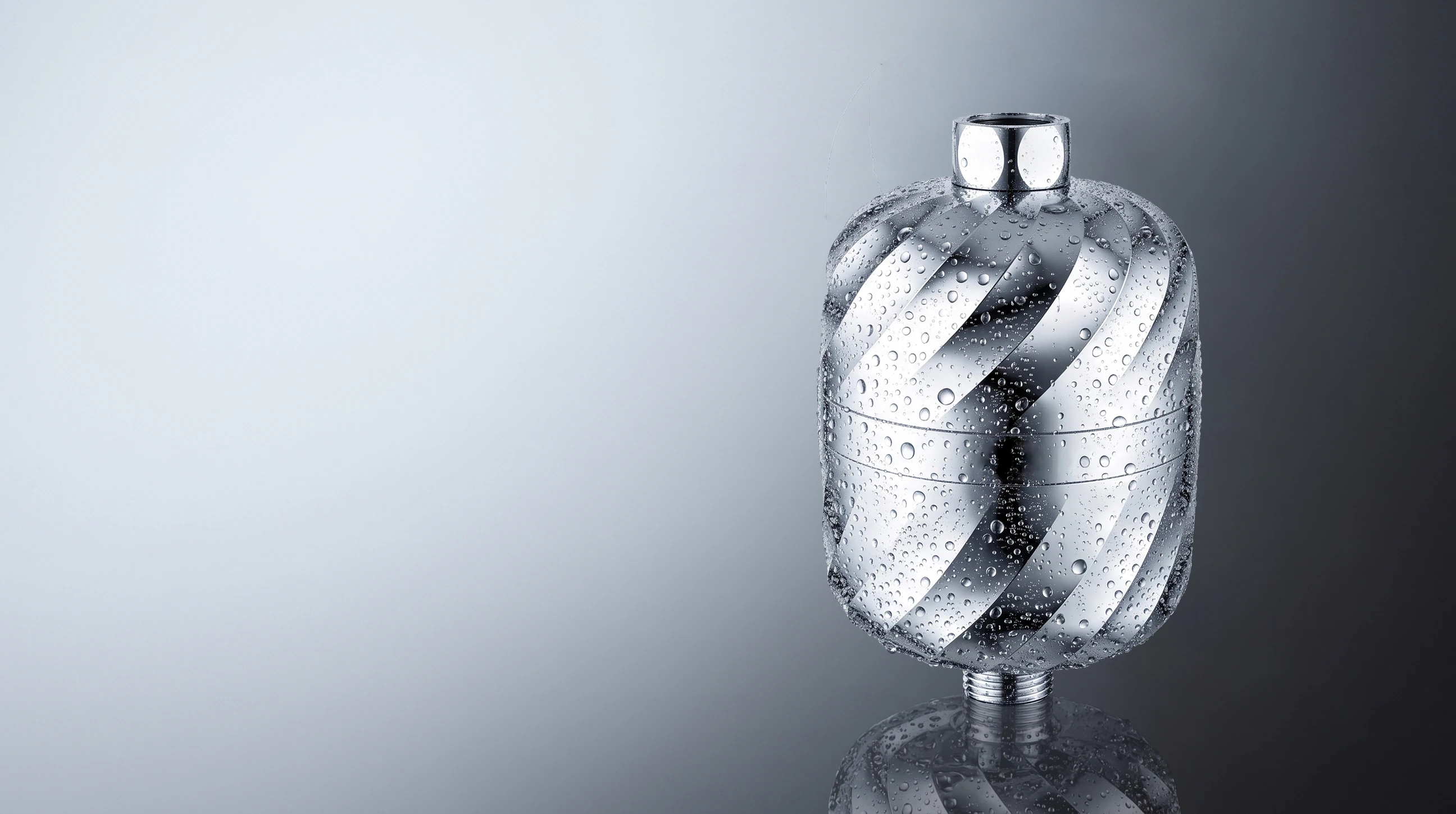
Hard water is the most commonly blamed — and most commonly misunderstood — cause of shower complaints. Buyers ask for a shower filter that fixes hard water. Suppliers sell one. Then the customer measures limescale six weeks later and finds it is still there. This article explains what hard water actually does, what shower filters genuinely change, and how to position a product so it does not over-promise.
What "hard water" means, precisely
Hardness is the concentration of dissolved calcium and magnesium, expressed in mg/L as calcium carbonate. The bands most suppliers use:
| Band | mg/L as CaCO₃ | Typical consequence |
|---|---|---|
| Soft | 0–60 | Lathers easily, minimal scale |
| Moderately hard | 60–120 | Slight film on glass, some soap scum |
| Hard | 120–180 | Visible scale, soap scum, dull hair |
| Very hard | 180+ | Rapid scale, clogged heads, appliance damage |
Two water supplies can both be "hard" and behave very differently, because hardness is only one variable. Alkalinity, pH and dissolved iron change how readily that calcium precipitates out as scale. This is why a cartridge that performs well in one city can underperform in another with the same headline hardness number.
What hardness does to hair and skin
The mechanism is not mysterious. Soap and shampoo are surfactants that need to form a lather and then rinse clean. In hard water, calcium and magnesium ions bind with the fatty acids in soap to form insoluble salts — that is soap scum. The consequences in a shower:
- Residue. The insoluble film deposits on hair and skin rather than rinsing away, which is what leaves hair feeling coated or "heavy".
- Cuticle roughening. Mineral deposition between cuticle scales makes hair feel coarser and tangle more.
- Reduced lather. More product is used to achieve the same cleaning, which is an invisible cost the customer never itemises.
- Scale on fixtures. The white crust on a glass panel or shower head is calcium carbonate precipitating out as water evaporates. It is a surface deposit, not something in the water flow.
The uncomfortable truth about shower filters and hardness
A shower filter — the kind that threads between the arm and the head, or sits inline behind the wall — does not soften water. Softening requires ion exchange: calcium and magnesium are swapped for sodium on a resin bed, and that resin must be periodically regenerated with salt. A cartridge the size of a fist, with no drain and no salt, cannot do this for weeks at a time.
What a shower filter does do is reduce free chlorine and chloramine, capture sediment and rust, and in some formulations reduce dissolved metals. Those are real benefits. They are also not hardness removal, and any brand that blurs the two is setting up a refund.
Hard water vs soft water: which is actually better for your shower?
For the shower experience specifically, soft water wins on almost every consumer-visible measure: lather, rinse, residue, fixture scale. For drinking, the picture is different — very soft water can be more corrosive to pipework and is sometimes associated with higher lead and copper leaching in older plumbing, which is why many utilities deliberately stabilise pH rather than push hardness to zero.
For a supplier, the practical framing is:
- Do not sell a shower filter as a softener. Sell it as chlorine, chloramine and particulate reduction, and be explicit that hardness is out of scope.
- If your market genuinely needs softening, the correct product is a whole-house softener or a point-of-entry system — a different category with different installation requirements.
- If a customer is complaining about scale on the shower head, the honest answer is descaling and, if hardness is very high, treatment at the entry point. A cartridge will not stop it.
Where the category can honestly win
There is a large and legitimate market for shower filtration in hard-water areas — not because the filter removes hardness, but because hard water and chlorinated water frequently occur together, and customers experience the combined result as "bad shower water". Reducing the chlorine component measurably improves how hair and skin feel. That benefit is defensible, testable to NSF/ANSI 42, and does not require overstating anything.
The strongest product positioning we see from successful brand partners is narrow and technical: state the media, state the tested standard, state the rated capacity in litres, state plainly that the product does not soften water, and let the improvement in feel carry the rest. It converts worse on the first page and far better on the second purchase.
A specification checklist for hard-water markets
- Get the local water report: hardness, alkalinity, pH, free chlorine versus chloramine, iron and manganese.
- Size media volume against the flow rate you will rate the product at, not against the head size.
- Publish capacity in litres, and state the test conditions.
- Include descaling guidance for the shower head itself — it protects your reviews.
- If hardness is very high, consider offering a compatible pre-filter or a whole-house referral rather than stretching the cartridge claim.
Bottom line
Hard water is real, its effects on lather and residue are real, and it is not fixable with a shower cartridge. The brands that grow in hard-water markets are the ones that separate the two claims cleanly. If you are specifying a cartridge for a hard-water region and want to work through media choice and rated capacity for that water profile, that is the kind of specification work our team does with OEM partners every week.
